

In classrooms across the world, a quiet revolution has been shaping the way children learn, think, and grow for over a century. Rooted in the pioneering work of Italian educator Dr. Maria Montessori, the Montessori method has long been celebrated for its unique approach to child development — one that prioritizes independence, curiosity, and hands-on exploration over rote memorization or rigid instruction. In a world where education systems often emphasize standardized testing and conformity, the Montessori philosophy offers an alternative that celebrates individuality and cultivates lifelong learning.
At its core, Montessori education believes that children are not empty vessels waiting to be filled with information but rather active participants in their own growth. Through carefully designed environments and child-led exploration, students learn not just academic content, but also the essential skills of self-regulation, problem-solving, and collaboration. The result is an education that doesn’t just prepare children for exams — it prepares them for life.
The Origins of a Revolutionary Approach
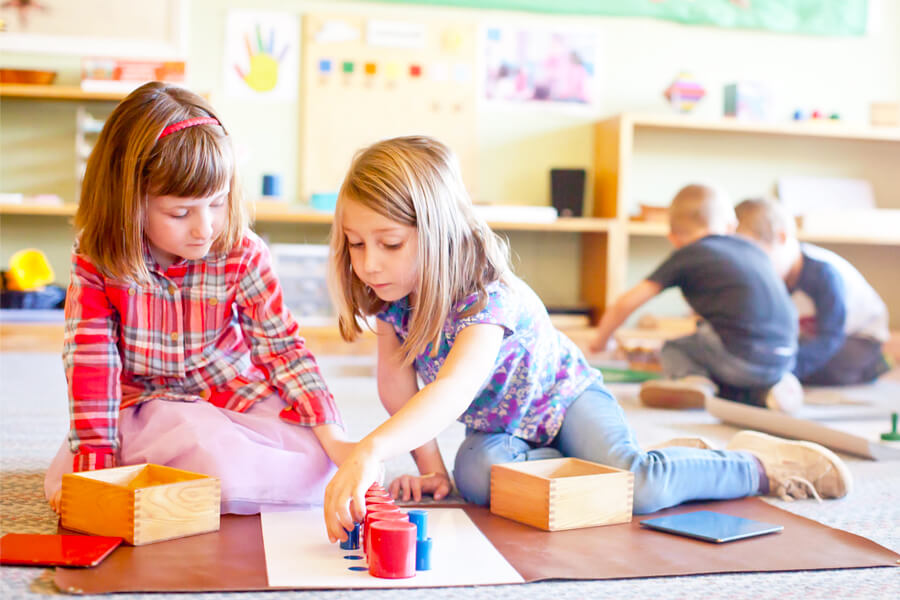
The Montessori method began in the early 1900s when Maria Montessori, Italy’s first female physician, observed children in a working-class neighborhood of Rome. She noticed that when given freedom within a structured environment, the children displayed remarkable focus, joy, and independence. They didn’t need constant correction or instruction — they needed opportunity and respect.
Montessori’s central insight was radical for its time: children are naturally driven to learn when placed in an environment that encourages exploration and self-discovery. She designed materials that appealed to the senses, promoted fine motor skills, and allowed abstract concepts to be understood through concrete experience. Mathematics was not a list of rules to memorize but a system of patterns to touch, see, and manipulate. Language, too, emerged not from drills but from meaningful interaction and observation.
Her early schools, called “Casa dei Bambini” (Children’s Houses), soon spread across Europe and beyond. Today, more than 20,000 Montessori schools operate worldwide, from preschools to high schools, and their graduates include innovators like Jeff Bezos, Larry Page, Sergey Brin, and Gabriel García Márquez — individuals whose creativity and independence echo the principles they learned as children.
Freedom Within Structure
One of the most distinctive aspects of Montessori education is its emphasis on freedom within limits. Children are free to choose their activities, but the environment is intentionally designed to guide them toward productive and meaningful learning. Every material has a purpose, every object a lesson hidden in its design.
Instead of desks arranged in rows, Montessori classrooms are organized into inviting learning stations — areas for practical life, sensorial exploration, math, language, and cultural studies. Children move freely through these spaces, selecting activities that align with their interests and developmental stage. The teacher, or “guide,” observes quietly, offering assistance only when needed, ensuring that learning remains self-motivated and purposeful rather than externally imposed.
This approach fosters autonomy and concentration. When a child spends thirty minutes carefully arranging colored rods to understand numerical relationships, that act of focus becomes a foundation for discipline and perseverance later in life. The classroom becomes a microcosm of society, where self-directed effort leads to genuine mastery.
Learning Through the Senses

Dr. Montessori believed that the mind is educated through the hand — that sensory experience is the gateway to intellectual understanding. Her materials are designed to engage multiple senses simultaneously, allowing abstract ideas to be grounded in physical reality.
For example, the “pink tower,” a simple stack of wooden cubes, teaches children about size, comparison, and balance long before they encounter formal geometry. Bead chains make numerical patterns visible and tangible. Even grammar, an abstract concept for many young learners, is taught through color-coded shapes representing different parts of speech, transforming language into something concrete and playful.
By engaging sight, touch, sound, and movement, children internalize knowledge in a deeper and more lasting way. This multisensory approach mirrors how the brain naturally learns — through active engagement, not passive reception.
The Role of the Teacher as a Guide
In traditional education, the teacher stands at the center — the authority figure who directs, explains, and corrects. In Montessori classrooms, this hierarchy is softened. The teacher’s role shifts from commander to observer, from instructor to facilitator.
Montessori educators are trained to watch closely, understanding each child’s interests, strengths, and challenges. Their goal is not to impose learning but to nurture it, stepping in at just the right moment to introduce new concepts or encourage deeper exploration. They cultivate trust rather than compliance, helping children build confidence in their ability to think and act independently.
This respect for the child’s agency builds not only academic skill but also emotional intelligence. Students learn to make choices, take responsibility for their actions, and collaborate respectfully with peers. They don’t work for rewards or grades; they work for the intrinsic satisfaction of mastery.
Intrinsic Motivation and the Joy of Discovery
Perhaps the most enduring gift of Montessori education is the cultivation of intrinsic motivation — the natural drive to explore, learn, and grow without external pressure. In traditional settings, children often learn to perform for grades, stickers, or praise. But such external motivators can limit curiosity and creativity.
Montessori environments remove these distractions, allowing curiosity itself to guide progress. When a child independently discovers how numbers work or masters tying their shoes after repeated practice, the joy comes from the achievement itself. This sense of ownership over learning fosters confidence, perseverance, and a love of discovery that extends far beyond childhood.
Neuroscience now supports what Montessori observed intuitively: intrinsic motivation activates the brain’s reward system more powerfully than external incentives. When children learn because they want to, not because they have to, their engagement deepens, and their retention strengthens.
Mixed-Age Classrooms and Peer Learning

Another hallmark of the Montessori system is its mixed-age classroom, typically spanning three years. Younger children learn by observing and imitating older peers, while older students reinforce their understanding by mentoring the younger ones. This dynamic fosters empathy, patience, and a sense of community rarely found in traditional classrooms.
The absence of competition and grading allows cooperation to flourish. Children become collaborators rather than rivals, and the classroom evolves into a social ecosystem where each individual contributes uniquely. In guiding one another, they develop leadership and communication skills that will serve them throughout life.
This peer-to-peer model mirrors real-world learning, where knowledge is shared horizontally as much as vertically. In many ways, Montessori classrooms anticipate the collaborative nature of modern workplaces, where initiative and teamwork are as valuable as technical expertise.
Real-World Skills and Lifelong Benefits
The practical life component of Montessori education — often overlooked by outsiders — is central to its philosophy. Activities such as pouring water, cleaning tables, gardening, or preparing food may seem mundane, but they teach coordination, responsibility, and respect for one’s environment. These daily tasks help children internalize the connection between effort and outcome, nurturing independence from an early age.
Montessori education builds executive function — the mental processes that govern planning, focus, and decision-making. By choosing and completing self-directed tasks, children strengthen the same neural circuits that underpin creativity, problem-solving, and adaptability in adulthood.
Research supports these outcomes. Studies have shown that Montessori students often demonstrate higher levels of social understanding, academic achievement, and emotional regulation compared to peers from traditional schools. They tend to approach challenges with curiosity rather than anxiety and exhibit a lifelong enthusiasm for learning.
Montessori in the Modern World
As education systems around the world grapple with rapid technological and social change, the Montessori philosophy feels more relevant than ever. Employers now value adaptability, collaboration, and critical thinking — precisely the traits nurtured in child-led classrooms. In an era where information is ubiquitous, the ability to think independently and learn continuously has become the ultimate skill.
Modern Montessori schools are also integrating technology thoughtfully, ensuring that digital tools complement rather than dominate the learning experience. Virtual experiments, coding exercises, and multimedia projects are woven into the curriculum in ways that honor the Montessori principle of hands-on exploration. The goal remains constant: to empower students to use tools — whether wooden blocks or tablets — as instruments of understanding, not distraction.
The Montessori Mindset for Parents and Society
The Montessori advantage doesn’t end at school walls. Many parents adopt its principles at home by creating child-friendly spaces, encouraging independence, and valuing curiosity over compliance. When children are trusted with responsibility, they develop the confidence to explore the world with purpose and respect.
In a broader sense, Montessori’s philosophy challenges society’s assumptions about education itself. It suggests that learning is not a race to accumulate information but a lifelong process of discovery and growth. When we nurture a child’s natural desire to learn rather than control it, we cultivate individuals who are not only intelligent but also compassionate, resilient, and self-aware.
Conclusion: Education for Life, Not Just for School
The Montessori approach endures because it recognizes something timeless about human development: that learning is most powerful when it is self-directed, purposeful, and joyful. In giving children the freedom to explore within structure, it teaches them how to think, not what to think.
Child-led learning builds the foundation for lifelong skills — independence, curiosity, focus, empathy, and adaptability. These qualities extend far beyond the classroom, shaping how individuals approach challenges, relationships, and work throughout their lives.
In an age of constant change, the Montessori philosophy offers stability through simplicity: trust in the child, respect for their rhythm, and faith in their natural capacity to learn. It is not merely an educational method — it is a worldview, one that sees every child not as a vessel to be filled, but as a flame to be kindled.


